Code Black and Blue: Part I (Workplace Violence)

Real ONA members like this one tell the shocking story of what it’s like working on the front lines where violence runs rampant.
Real ONA members like this one tell the shocking story of what it’s like working on the front lines where violence runs rampant.
It was a sobering moment at ONA’s recent Biennial Convention.
Provincial President Erin Ariss asked delegates – almost 1,000 – to raise their hand if they’ve ever been assaulted, verbally or physically, at work.
Just about every hand went up.
That alarming visual is the reason behind ONA’s latest Nurses Talk Truth advertising campaign, Code Black and Blue. As the name suggests, the powerful campaign reveals the reality of a bruised and battered workforce, highlighting that a lack of staff is the biggest contributing factor, and calls a code for urgent action.
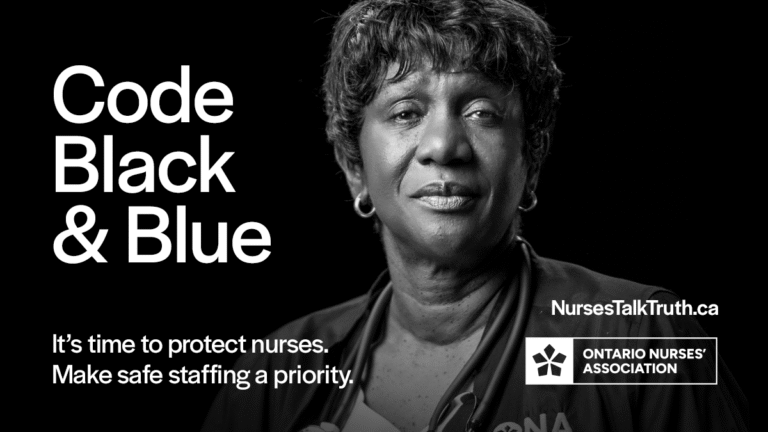
“In what workplace is it acceptable to be kicked, punched, pushed, spit at or strangled; where insults and threats are hurled at you but you are expected to continue working without support?” asks Ariss, revealing that during her decades as an emergency department [ED] nurse, she “stopped counting assaults when the total hit 1,000.”
Tragically, she isn’t alone.
“This pretty much happens daily in the ED,” explains member Cayley (we aren’t using our members’ last names in this story). “I have people angry with me. There are instances where...they’re trying to kick, bite or spit at us and security. It can be quite dangerous.”
But this isn’t unique to the ED. In fact, members on other units say they often end up there themselves.
“When leaving your shift, you’re heading to the emerge for help,” says member Tara. “You’re not able to go home to your family because you have to deal with the broken fingers you got from your patient. We didn’t sign up to be hit and punched; we signed up to care for people.”
Her fellow member Michelle concurs, adding the reality of workplace violence came as a shock. “When I first started nursing school, I had no idea I would be at risk of being physically assaulted and verbally accosted. It was a very real world introduction into what bedside nursing looks like.”
Statistics support what these members are saying.
Workplace Safety and Insurance Board data obtained by ONA from 2021 to 2024 show that health-care workers missed 130,438 days of work due to workplace violence and harassment. During that same time, the benefit costs associated with violence were more than $38 million.
of respondents to a CFNU survey have experienced physical abuse in the past year.
The Canadian Federation of Nurses Unions’ white paper on workplace violence also highlights that 63 per cent of respondents experienced physical abuse in the past year alone, while 89 per cent experienced verbal abuse. Also deeply troubling is that 31 per cent revealed they didn’t report any incident for fear of repercussion.
“Ironically, our employers’ response when something like this happens is yet another form of abuse,” states Ariss. “They blame us, as if we did something to provoke violence or failed to do something to prevent it.”
“We’ve been conditioned and expected to just take the violence, disrespect and harassment,” agrees member Elma.
Unfortunately, even when violent incidents are reported, our members have no assurances that anything will be done. In the vast majority of workplace assaults on nurses, no criminal charges are laid. In fact, between 2006 and 2021, researchers found just 12 English-language sentencing decisions involving nurses as victims of violence, and five prosecutions under Ontario’s Occupational Health and Safety Act for such incidents.
And while ONA stresses the importance of training and prevention tools, 37 per cent of respondents shared with the CFNU that they hadn’t received any workplace violence training at all. ONA members also report that many of the programs that are available are woefully inadequate.
“A written statement hanging on the wall saying violence won’t be tolerated does nothing to protect nurses,” notes Ariss. “That needs to change.”
Through a series of powerful black and white television, transit shelter, social media and print ads that are running for a five-week period this fall, along with a dedicated microsite to seek the public’s support, Code Black and Blue is aiming to do exactly that.
The stark and raw ads feature front-line members, many of whom are featured in this story, drawing back the curtain on a shocking reality many Ontarians don’t even realize exists.
“To be frank, the amount of violence I encounter on a daily basis would shock the general public,” says member D’Arcy while her fellow member Rhonda adds, “I don't think the public knows how we get verbally and physically abused on a daily basis, and that it’s unfortunately just our norm. It's getting worse and worse as the years go on.”
That’s something that greatly worries member Heather.
“More people are carrying weapons, so there's that added risk. Five years ago, I may have been kicked or punched. Now I'm thinking, are they going to pull a knife? Are they going to have a gun on them? Because the landscape has changed so drastically.”
Premier Doug Ford is well aware of the problem. Yet, despite ONA’s decades-long work fighting to improve workplace safety, his government and our employers continue to fail us. Adding insult to injury, quite literally, is the fact that the safety of other first responders, such as firefighters and police, is taken far more seriously.
“When they’re assaulted, they’re immediately relieved of work and provided with all the supports they require,” explains Ariss. “And so it should be. But that’s not how it is for nurses and health-care professionals.”
Thankfully, ONA knows how to help fix it. While fully addressing workplace violence takes a multi-faceted approach, reversing the biggest contributor – understaffing – is paramount.
“This problem is absolutely solvable,” explains member Ashley. “One of the solutions is safe staffing ratios because that would ensure our clients receive the care they need. It would ensure that we have fewer nurses who are feeling the weight of burnout, pressures and anxieties just showing up to work.”
She’s right. The benefits of mandatory nurse-to-patient ratios can’t be understated: Research shows that:
Legislated staffing ratios are also being implemented in British Columbia and Nova Scotia, and several states south of the border already have them. Yet, in ONA’s last round of hospital bargaining where we proposed ratios for this province, “the response from the Ontario Hospital Association (OHA) was to fight them tooth and nail,” reveals Ariss. Arbitrator Sheri Price also didn’t include them in her subsequent decision.
“Here we are again fighting for staffing,” says member Rachel. “We’re not being heard or respected. We’re being dismissed.”
Member Carolyn adds, “we can’t meet all of our standards because we just don't have the manpower or proper ratios. And it can become scary at times because when we're really short-staffed and/or having surges of acuity or volume, we can’t deliver the kind of care we want.”
And that results in an even bigger exodus of fed up and burnt out nurses and health-care professionals, increasing workloads and exacerbating workplace violence.
“The more we don't address the issue of burnout, the more we put the stressors back on nurses who are working short-staffed and long hours, who are dealing with physical, emotional and verbal abuse, and not getting the support they need,” says member Kerri. “You see why they walk away, and more stress is left on those that are there trying to keep the boat afloat.”
“The Ford government says they’re hiring thousands of new nurses, but I have yet to see that, especially in Northern Ontario,” adds member Teagan. “In fact, I’m seeing more nurses leave the profession than coming in.”
And these aren’t just nurses and health-care professionals who have been in the profession for years or those who have decided to retire early. Member Lauren explains that she graduated nursing school in 2020 and “many of my graduating class have already left the profession.”
But enough is enough. ONA refuses to accept anything less than safe workplaces.
“Employers and the Ford government have been put on notice that the days of nurses and health-care professionals simply accepting being injured at the hands of others are long over,” concludes Ariss.
“In fact, I’m determined to lead a revolution to end workplace violence and unsafe staffing once and for all. And I need all ONA members and the public to join me.”
You should be entitled to go into work and not be abused verbally or physically by the people you're trying to help.
After all, as member Brenda states, “you should be entitled to go into work and not be abused verbally or physically by the people you're trying to help. That’s really all we're asking for: to not have to worry about if we’re safe at work.”
Learn more and send an email to your MPP to support our demands here.
In Part II, F-Word will focus on the serious issue of intimate partner violence, which often spills into our workplaces.
This is a standard popup that can be repurposed for general site-wide messages.
We use cookies to improve your experience on our website. To learn more, read our privacy policy.