Meeting my MPP: Part I

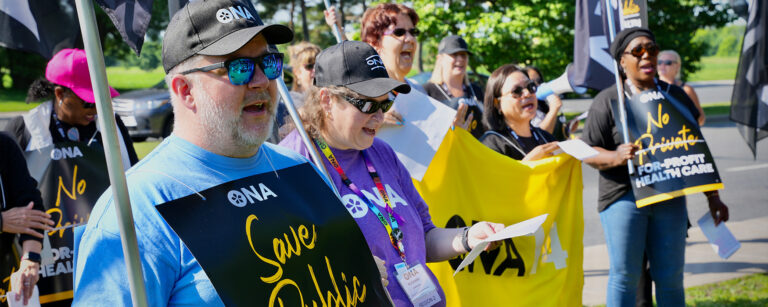
Meeting her MPP was just the latest display of activism for ONA member Luisa Guevara (left), who is seen here asking a member of the public to sign a petition in support of striking LCBO workers in 2024.
Meeting her MPP was just the latest display of activism for ONA member Luisa Guevara (left), who is seen here asking a member of the public to sign a petition in support of striking LCBO workers in 2024.
In this series, F-Word is highlighting the experiences of three ONA members who met with their MPPs to discuss the Ford government’s disastrous closure of supervised consumption sites (SCS), and who encourage other members to do the same.
When we asked members at an SCS briefing session if they would be interested in meeting with their MPPs, Luisa Guevara was only too happy to sign up.
“I wanted to meet with [newly elected Liberal MPP for Ajax, Rob Cerjanec] “because I was told by ONA that he didn't take part in the vote on supervised consumption sites as he wasn’t elected yet, and I knew he was pro-health care and pro-education,” says Guevara, who is the Return to Work Representative lead for Toronto Western Hospital. “This issue affects both.”
It’s something that Guevara said she didn’t know a lot about herself at first.
“They’re places where people with no OHIP can get care,” she explains of SCSs, which ONA knows not only lessen the strain on our already maxed health-care system, but save lives. “Where people with drug addiction issues can get support – not only if overdosing, but with so many other things, such as housing and financial assistance. I had no idea until an ONA provincial meeting where [harm reduction/street nurse and new ONA staff member] Hannah Stahl spoke. I was amazed at all the services they provided, which likely means others didn’t know either.”
These MPP meetings are the latest in ONA’s continuing efforts to fight back against the Ford government’s closing of nine provincially funded SCSs last spring due to their proximity to schools and daycares, banning of new sites from opening and defunding of remaining sites. Instead, they shifted from a harm reduction to an “abstinence-based approach” by launching new homelessness and addiction recovery treatment (HART) hubs. Read more here.
“Working at an acute care hospital, I see the difficulties this vulnerable population faces,” Guevara explains. “Many don’t like to be in hospital, and some treatments get missed because they leave the unit and often don’t come back. As a caregiver, it’s very hard as we want to help them get better. But we have no way to reach them as some are homeless and some have no cell phones.”
Unlike with some MPPs, especially Conservative ones, Guevara says it wasn’t difficult to get a meeting with Cerjanec. After sending his office an email, she received a response within two days, and a meeting was set up.
“We decided to do it via Microsoft Teams, as it was easier than trying to get dates for an in-person meeting,” she notes.
Joined by ONA Region 3 Vice-President Karen McKay-Eden, Guevara went into the meeting armed with “helpful information from ONA staff to keep me on track,” along with research she had done on SCSs on her own.
“I mentioned what I see in my home area and what I know happens in workplace,” she explains. “My MPP was able to understand as he works in my area, but lives downtown [Toronto]. We also talked about how the Ford government’s different bills [Bill 6 and Bill 23] affect this population.”
And she reports that her MPP was very receptive to what she and McKay-Eden had to say. “He gave us input into his stand. He was on our side and said he also didn’t agree with Bills 6 and 23. I feel we added to his baseline knowledge about the differences between HART hubs and supervised consumption sites. He committed to helping us with this fight and said he would get one of his colleagues to also support us. He asked a lot of questions as well. Overall, he was very supportive, and I really felt that he was listening.”
While optimistic her MPP will take this information back to the legislature when it resumes in late March, she also urges other members to meet with their elected officials on this subject (or any other of importance to them and our health-care system).
Meeting with your MPP is a chance to have your say so they can understand the real situations and maybe change their minds.
“Meeting with your MPP is a chance to have your say so they can understand the real situations and maybe change their minds,” she says. “If you saw things prior to supervised consumption sites, you know we need them. Removing them is only going to add to the emergency room backlogs we currently have, and block beds when they don’t return and we have no way of finding them.”
These meetings also provide a chance to dispel and correct the blatant misinformation the Ford government has been spreading to try and convince Ontarians that their misguided plan to close SCSs makes sense when it’s clear they haven’t got a clue about the significant role these sites and the staff who work at them play.
“They’re not just a place to get clean needles and do drugs,” concludes Guevara. “That’s the perception the public has, and it’s not clarified by anyone in government. They also provide a wide range of services, including primary health care and referrals for housing, counselling, etc. We need to educate everyone.”
This is a standard popup that can be repurposed for general site-wide messages.
We use cookies to improve your experience on our website. To learn more, read our privacy policy.