In this series, F-Word is highlighting the experiences of three ONA members who met with their MPPs to discuss the Ford government’s disastrous closure of supervised consumption sites (SCS), and who encourage other members to do the same.
ONA member Karen McCoy’s quest to meet with her MPP began with a simple knock on her door.
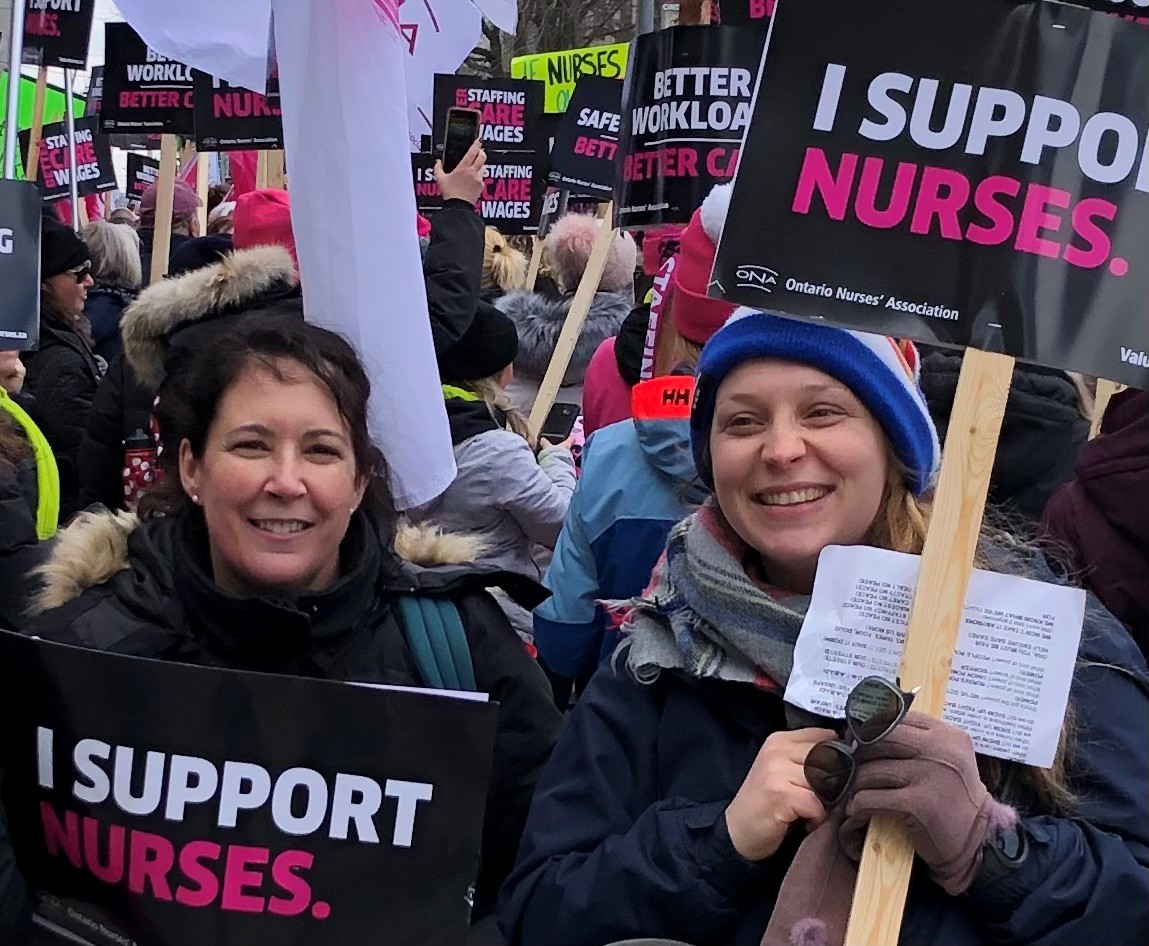
“I felt the meeting with our MPP was positive,” says ONA214 Local Coordinator Karen McCoy (left), who met with MPP George Darouze (Carleton) to discuss supervised consumption sites with fellow member Meagan Stewart, seen here at an ONA rally.
“During the provincial election campaign last year, my Conservative MPP George Darouze [Carleton] knocked on my door during canvasing,” she says. “I asked about the closure of supervised consumption sites as he was a city councillor during the votes and city discussion on that. His rationale as a councillor was that the province should pay for these supervised consumption sites and not the cities. His response was that after the election, he would meet with us to discuss.”
But that meeting didn’t come about quite so easily.
I reminded him that I’m his constituent and that he had said he would meet with me.
“My request for an initial meeting following the election was met with a coordination of dates and then the offer to do an email exchange about the concerns,” McCoy explains. “I declined and asked for an in-person meeting. I reminded him that I’m his constituent and that he had said he would meet with me after the election.”
That did the trick.
To prepare for the meeting, which took place in Darouze’s constituency office last November, McCoy, who is Local Coordinator for ONA214, and fellow member Meagan Stewart met with Government Relations and Mobilizing staff and conducted her own research, reviewing SCSs in the Ottawa area.
These MPP meetings are the latest in ONA’s continuing efforts to fight back against the Ford government’s closing of nine provincially funded SCSs last spring due to their proximity to schools and daycares, banning of new sites from opening and defunding of remaining sites. Instead, they shifted from a harm reduction to an “abstinence-based approach” by launching new homelessness and addiction recovery treatment (HART) hubs. Read more here.
“I felt the meeting with our MPP was positive,” McCoy notes. “There was dialogue and listening to both points. He remembered meeting me, which I know was true as he recalled that I was having my HVAC fixed the day he came to my door. He had a binder and took notes, and gave an overview of the HART hubs and the discussions he has had around them. He accepted material we gave him from ONA regarding supervised consumption sites.”
For McCoy, this is an important discussion that needed to be had, as the closure of SCSs has negatively impacted many Ontarians and has a domino effect on other health-care sectors.
“Supervised consumption sites are important to the those they serve in the community. Services should be provided where an individual is at in their journey. The HART hubs don’t provide safe consumption, so we’re missing a key element in caring for these individuals. We should be concerned about the risk of increased overdoses and stress on emergency departments. There should be a way to have a partnership between safe consumption sites and HART hubs.”
While meeting with an MPP can seem intimidating, McCoy reminds other members that they’re here to listen to and serve their constituents.
“They’re individuals doing a job,” she notes. “We may disagree with the policies, etc., but we can sit and have constructive conversations. Don’t be discouraged and remember, you’re making a difference. Advocacy is part of being a registered nurse and health-care professional. We have the power, and we need to speak out on health care.”
This is a standard popup that can be repurposed for general site-wide messages.
We use cookies to improve your experience on our website. To learn more, read our privacy policy.