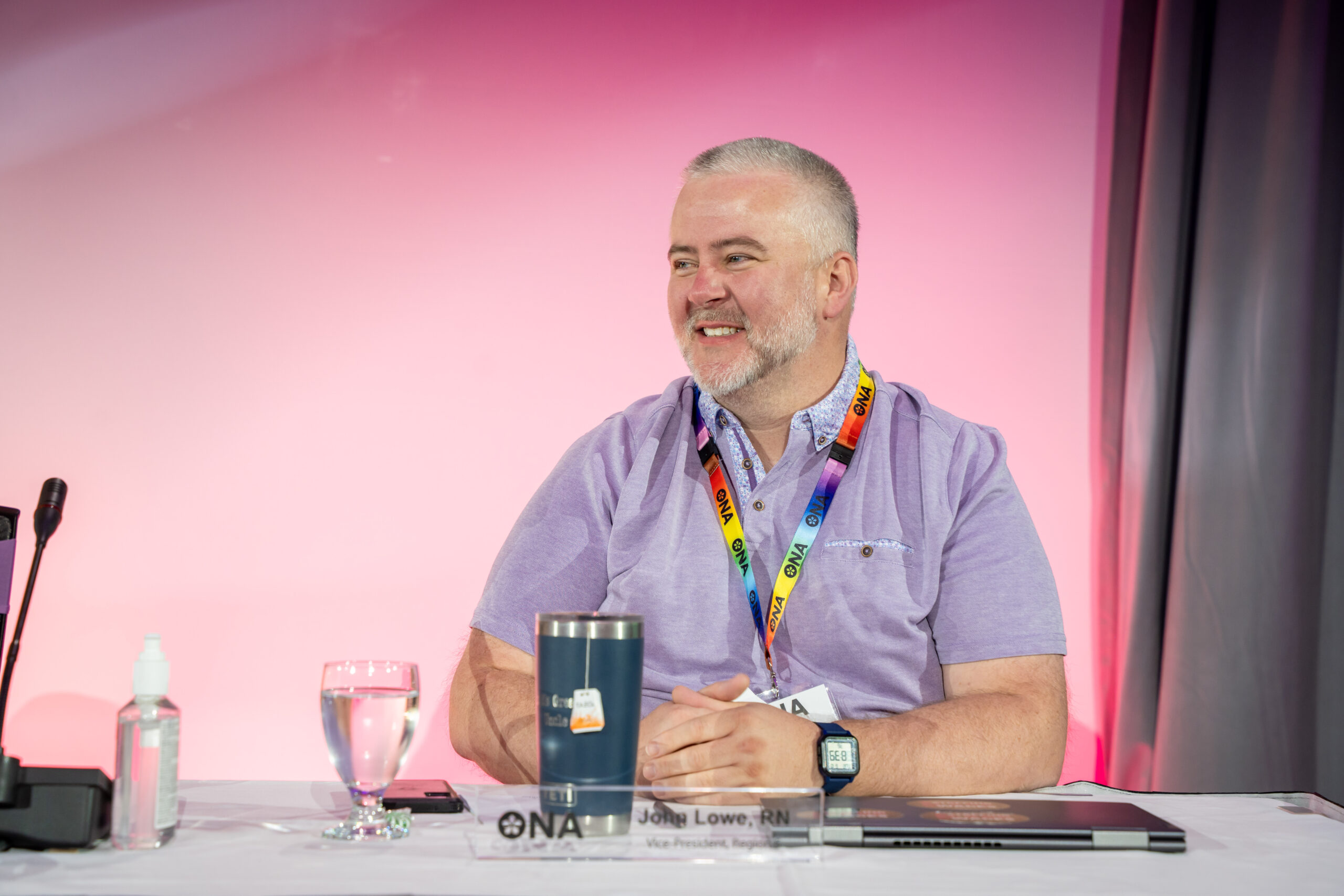
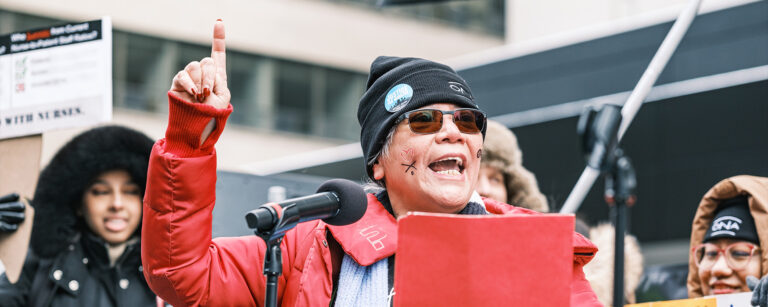
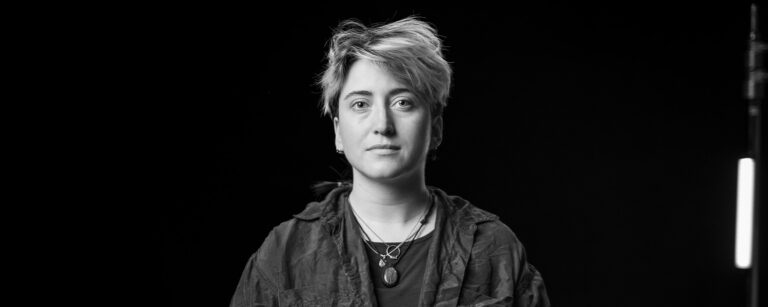
Now that Region 5 Vice-President John Lowe has had a chance to get his feet wet for a few months as the newest member of ONA’s dedicated Board of Directors, we thought you might like to get to know him.
And the first thing that’s abundantly clear is that he’s no stranger to hard work. Then again, as an RN for 22 years, a Local Coordinator for 10 and a former two-term municipal councillor for the Huron County village of Brussels (population 993), where he has lived since birth and continues to volunteer, he knows how to multitask.
“Busy people just seem to know how to make things work and get them done,” he says. “If there's a need to help, I'm there. I don't like anything unfilled; that's just my nature.”
No rabbit holes
And he has applied that to all aspects of his life, including his union involvement, which began soon after he graduated from St. Clair College in Chatham.
“First, I was the ONA21 health and safety rep, which started back in 2006 and continued until about 2016,” Lowe states. “That's how I got involved with ONA. Dianne Miller, the Local Coordinator at the time, saw that I had an interest and must have thought, well, let's get him on the Local executive. It worked because a vacancy came up for the Local Secretary position, and I held that for two terms in 2013-14. And when I found out Dianne was retiring, I put my name forward and was first acclaimed as Local Coordinator in 2015.”
Lowe would go on to serve in that position for five consecutive terms while also sitting on a number of ONA provincial committees. Those included the Elections Team, where he was proud to be part of “ONA’s important work to strengthen policies and ensure there were no rabbit holes in the process,” Provincial Coordinators Meeting (PCM)/Biennial Convention Design Team and the Hospital Provincial Negotiating Team.
Great support
“I really enjoyed being a Local Coordinator,” he explains, adding he has never been a Bargaining Unit President. “I’ve seen all the changes and it was great interacting with all the other Local Coordinators over the years.
“Before I put my name forward for Region 5 Vice-President, I thought it was important to have a good base and a good background, and being a Local Coordinator helped me achieve that. So, I felt like I was ready to step up, and was at a time in my life where I could shift gears into this new position.”
As Region 5 Vice-President, a position that became vacant when former Region 5 Vice-President Alan Warrington was elected as First Vice-President last spring, Lowe is representing members in southwestern Ontario, bringing their concerns to the entire Board so they can be addressed.
The same applies to any issues in his Board portfolio of contract administration.
“While I didn't deal with a lot of that as a site rep, I would gather the facts around grievances and show them to the Bargaining Unit President,” Lowe notes. “This has been a learning curve for me, but I've got great support from the rest of the Board and staff.
“We've heard from members that their biggest frustration is how long it takes to get arbitration dates for their grievances. They wait and wait because there's not enough arbitrators. How can they get justice? That’s a huge challenge that's unfair to members, which the Board will continue to address.”
Rural life
Lowe is also committed to bringing the unique perspectives of rural nurses and health-care professionals forward.
“Rural health-care settings are obviously smaller, which means they have fewer resources and staff. But that only makes us more resourceful. We're very clever about making things work with what we have. We’re resilient, that's for sure.”
He adds that he worked as an emergency department (ED) nurse at nearby Clinton Public Hospital for most of his career until it suffered a reduction in ED hours in 2021, which affected his schedule and the schedules of many of his colleagues. Some, including Lowe, transferred to the ED at Seaforth Community Hospital, also part of Huron Perth Healthcare Alliance, where he has remained. While he worked in Stratford General Hospital’s intensive care unit (ICU) for about three years to get some critical care experience, he notes it’s still a small city hospital, with only a handful of ICU beds, compared to several times that amount at a large urban hospital.
F-words
One thing members have in common at all health-care settings though? The need to push back together.
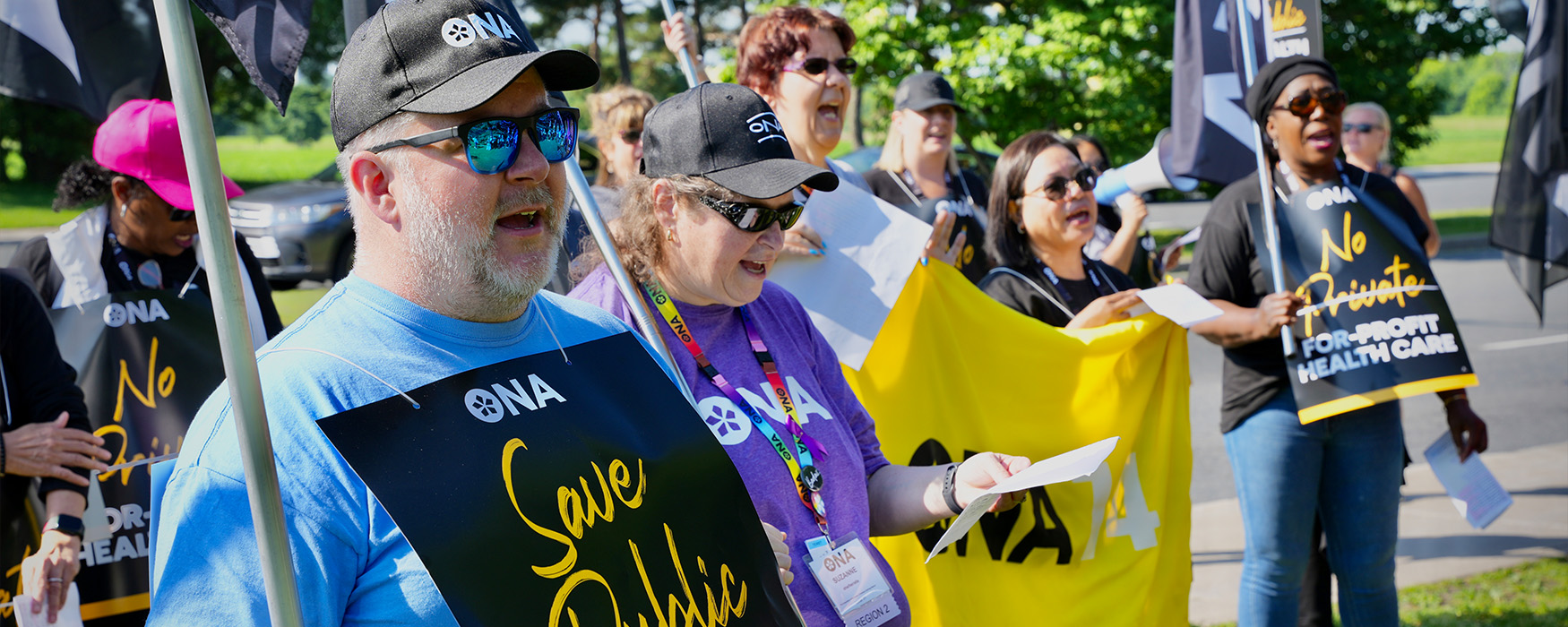
“We have to fight. It shouldn't be that way, but it is with the Ford government and many employers. And with that f-word comes another: Fear. Because we see fear from employers when we’re out making a big stink and getting attention. I truly believe that if we didn’t do that die-in [at the April 2023 PCM], the arbitrator wouldn't have given us a good hospital contract.
“And what we do in our fights – and here’s another f-word – is factual. We're not making things up. It’s the facts that we're presenting.”
He adds that while he’s seeing more members out on the streets protesting both locally and provincially than ever before, “to keep employers on the edge with the uncertainty of what we’re going to do next and instill even more fear into them” will involve us all.
“Another good f-word going forward is fortitude. We have to keep up all these actions and have a strong presence as thousands of ONA members. If you can just give a little bit of time – it doesn't mean you have to spend four hours at an action – it will make a big difference.”