ONA members have succeeded in their fight for a reprieve on the closure of the Mobile Crisis Intervention Team (MCIT) program.
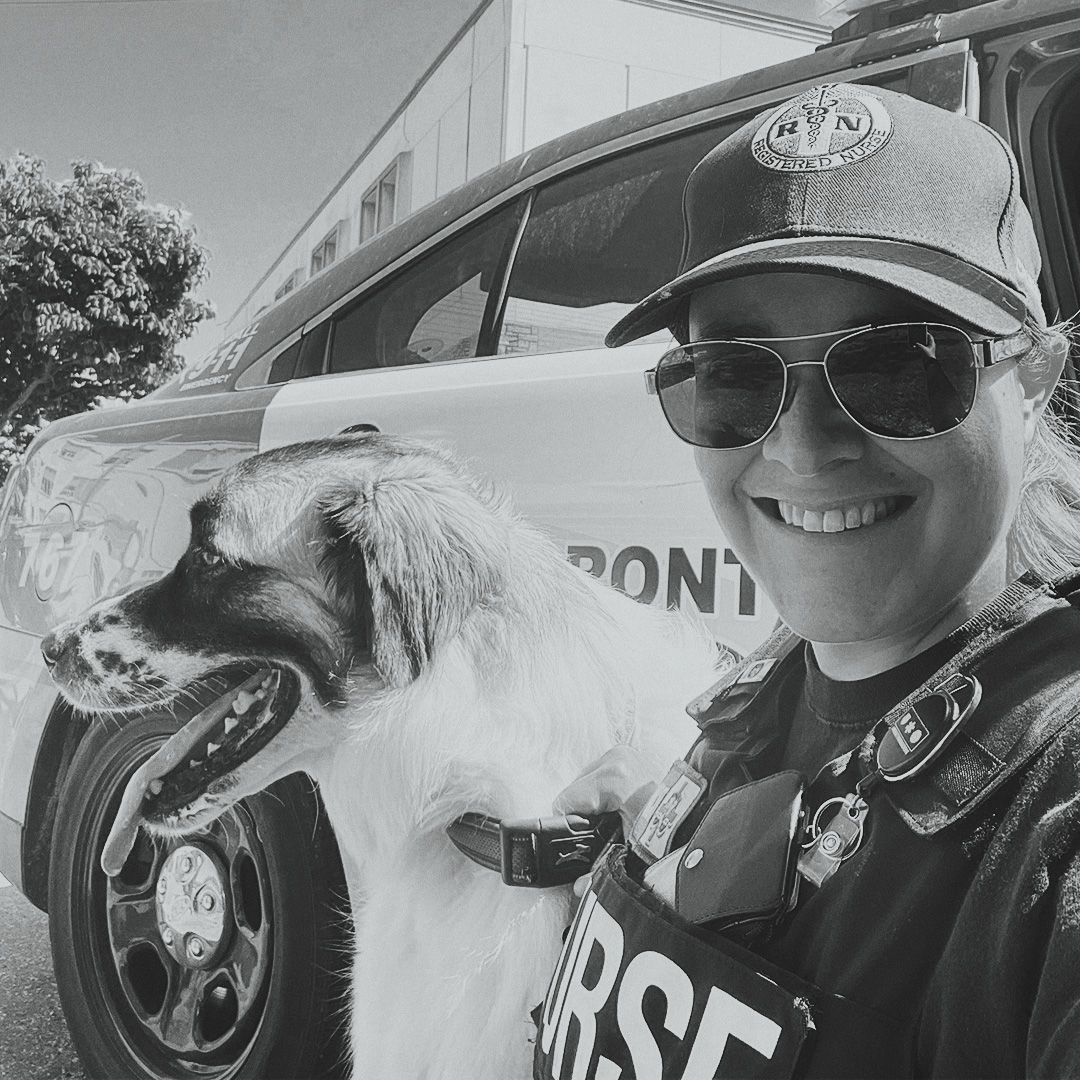
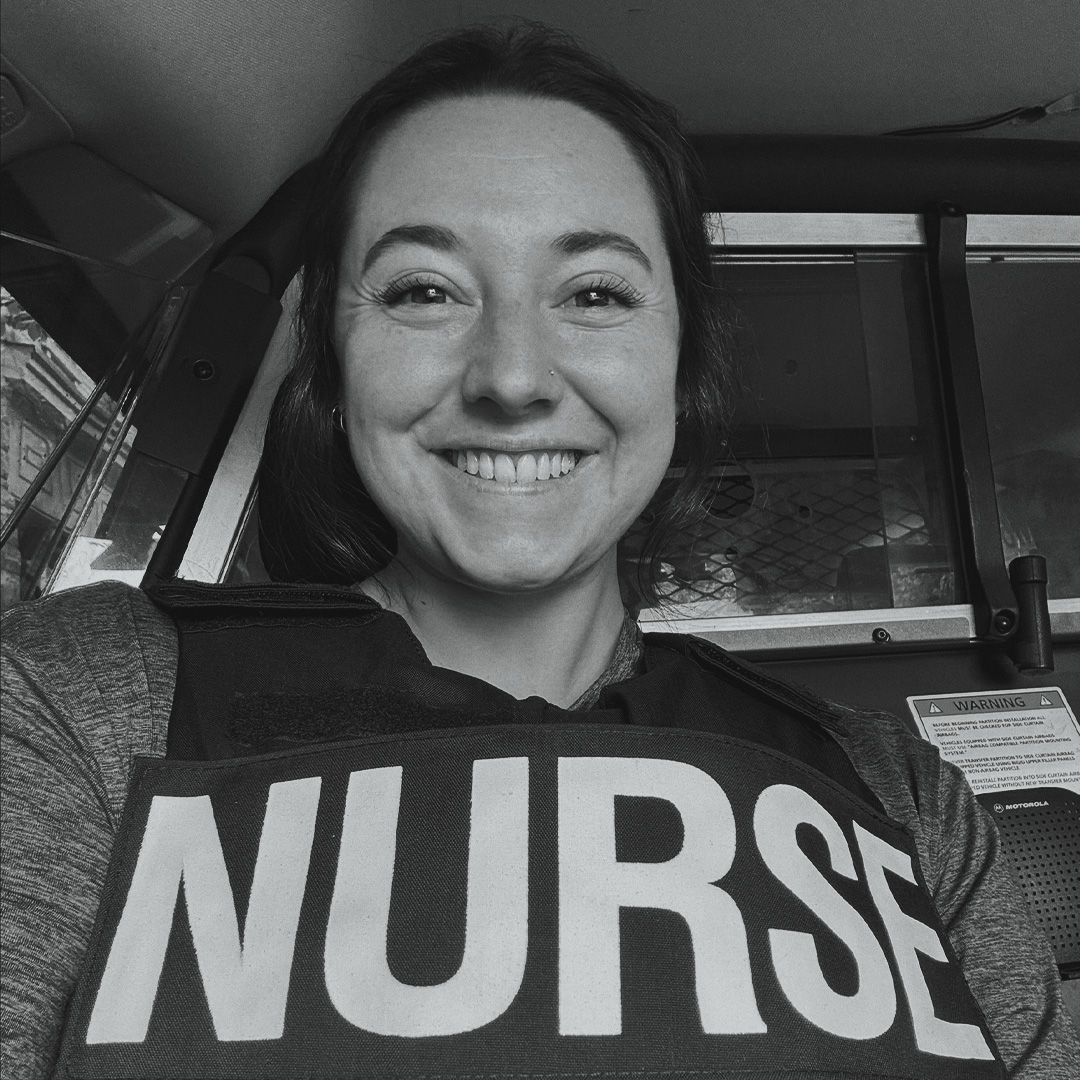
Registered nurses Melissa Mosneanu (left), seen here with a lost dog she located, and Brianna Ducharme say they are hopeful the Mobile Crisis Intervention Team program will stay beyond the end of 2026 because of their advocacy efforts.
Last fall, these members learned that this 25-year program, a collaborative partnership between Toronto Police and six area hospitals (North York General, St. Michael’s, St. Joseph’s under the Unity Health umbrella, Scarborough Health Network, Humber and Michael Garron), would be discontinued at the end of 2026.
Worth saving
But, as two ONA members explain, it’s worth saving.
“This program partners a psychiatric or crisis nurse with a specially trained police officer who has done extra training in the realm of mental health,” explains Melissa Mosneanu, a MCIT nurse for five years. “Usually, they’re further along in their policing career, so we get quite seasoned officers, which really helps because we’re dispatched through 911.
“That means a call about someone who is experiencing a mental health crisis, which could be anything from being on a bridge or in psychosis or going through difficulties behaviourally due to substance use. Or when young children are going through mental health or behavioural issues, and their parents or schools call us.”
“Having the ability to get somewhere really quickly is essential in this role,” adds Brianna Ducharme, an MCIT nurse for two years, who covers four divisions over a vast area. “Otherwise, our clients might not have made it.”
MCITs were developed to address gaps in how mental health crises were handled, especially when police are the first responders, recognizing the need for nurses’ clinical training to de-escalate such situations and provide pathways to appropriate care. The program, which employs about 35 full- and part-time nurses and pulls from the 5,000 officers of the Toronto Police Service (TPS), consists of a morning and afternoon shift of 10 or 11 hours – or longer if they receive a call at the end of a shift.
“We’re there until that call is done,” says Mosneanu. “I’ve been on a bridge for six hours trying to talk somebody off. And then I’ve gone to a call where it's somebody I know quite well and I’ll be like, oh, hey, what's going on today? and it can be quite a short call. We aren’t tied to a timeline. Sometimes we have back-to-back-to-back calls and sometimes we have a lull.”
During such lulls, MCIT nurses informally debrief with their officers, going over calls from previous days or from other divisions. Sometimes they use that time for mandatory training.
A huge benefit of the program is that when MCIT attends a call, they assess the person in crisis and connect them to an appropriate follow−up service, which is one of the reasons Mosneanu, who worked as a crisis emergency department (ED) nurse for 12 years, says she wanted to take this role.
“I got tired of police officers bringing in people that shouldn't be in the hospital, taking up space when they should be sent to another place.”
However, in some cases, the person in crisis is taken to hospital. MCIT nurses facilitate that transport, whether it’s riding in the back of the ambulance or following along in the MCIT police car, which is silver and intentionally muted, simply reading “Toronto Police” on the side to reduce stigma and promote safety and dignity.
“When we arrive at hospital, we’re doing the triage or SBAR [situation, background, assessment and recommendation] handoff with the ED staff to recognize the severity of the act and get that person mental health help,” explains Ducharme, who worked for eight years in in-patient psychiatry. “To see someone where they’re at in that immediate moment has been a great transition for me instead of being there after the crisis, developing a care plan in hospital and starting treatments. This role gets me out of the building and into the sunshine.”
Dumbfounded and confused
So, it’s no surprise the two say they were completely dumbfounded and confused when they found out last fall that the program may be ending at the conclusion of 2026 through an email sent by TPS to some of their partners, who then shared with them.
There was no reason given as to why this program should be sunsetted.
“We weren’t told directly and were caught completely off guard,” says Ducharme, noting there was no consultation process. “We didn’t even have an inkling. There was no reason given as to why this program should be sunsetted. Even after the Toronto Community Crisis Service (TCCS) came about two years ago and I thought, uh-ho, I hope they don't replace us, every officer told us they’re never getting rid of MCIT.”
While the TCCS provides free, confidential, in-person mental health supports Toronto-wide, Mosneanu and Ducharme note it’s mostly provided by peer-led support and non-regulated health-care workers, such as crisis workers; doesn’t assist anyone who is under the age of 16, acutely suicidal or in the act of wanting to end their life by suicide, or is intoxicated; and doesn’t handle calls involving violence or weapons.
“They're a fantastic team,” says Mosneanu. “There are calls where someone is lonely and a little sad and doesn't have access to resources. You don't need MCIT for that, but TCCS is a great resource.”
Adds Ducharme, “we use different skills and have advanced nurse training. We use the Violence Assessment Tool or the Columbia Suicide Scale, and have access to ConnectingOntario, which allows us to go to calls prepared with medical history. We’ve reviewed the med list and previous discharge summaries. We can call the psychiatrist and the Assertive Community Treatment Team, or the pharmacy to ask if this person picked up their meds. We’ve gone to calls where we've had to provide medical aid. We’ve de-escalated situations. All these things we can do because we are RNs. Our role is unique and can’t be filled by any other sort of crisis worker.”
They also worry that by removing MCITs, there will be no one to attend to mental health crisis calls involving violence or an acuity because it’s not within the TCCS’s mandate. That means a huge catchment of the city’s population will receive police-only response without MCIT nurses, who bring the clinical approach and skill of a regulated and trained health professional.
We’re able to go to these calls and add that health care lens, which is so important.
“If someone has a weapon or is going to hurt themselves or someone else, police are attending no matter what to ensure safety and enforce the Mental Health Act,” explains Ducharme. But with MCITs, “it can be enforced in a way that’s more therapeutic, trauma-informed and in the best interest of the client,” adds Mosneanu. “We’re able to go to these calls and add that health care lens, which is so important.”
But, they’re quick to point out, there is room for both programs.
“They both have their benefit,” says Ducharme. “No one is saying one is less important than the other. One team has a role, and the other team has a role. We believe that there is room in this city for both, and there should be multiple ways to seek out crisis support.”
While the creation of the TCCS isn’t the official reason for the end of their program, “it’s definitely something that has been mentioned in the two public forums the TPS have had with their Board and regarding the recent city budget,” says Mosneanu. “The Chief says health is health and mental health should be health-led, and he’s right, but the nature of people who are severely mentally ill is that there are circumstances where there is violence and MCIT is best placed to respond.”
Fight back
Not content to sit back and watch their program disappear, these members, along with their fellow MCIT nurses, immediately planned their fight-back.
“I reached out to ONA requesting support and assistance because we weren’t sure what to do from the union perspective,” explains Ducharme. “We were connected and it took off from there. We also had a meeting with ONA Provincial President Erin Ariss.”
They also credit the support of their officers with whom they have a close relationship, various nursing and other organizations and individuals, including the Canadian Federation of Mental Health Nurses, the Registered Nurses’ Association of Ontario, the Centre for Addiction and Mental Health, the Schizophrenia Society of Canada, some Toronto councillors and the Toronto Police Association (union), “which were huge advocates right from the get-go and hit the ground running for us,” says Mosneanu.
“All these organizations got behind us, helping us write letters, attend a meeting at the Toronto mayor’s office and do a lot of other advocacy work, including speaking to the media” (Ariss also wrote a letter to Health Minister Sylvia Jones and Councillor Shelley Carroll, Chair of the TPS Board, highlighting research that shows clients have a positive view of the MCIT program, especially nurse involvement in crisis response). “Because of this advocacy, at the TPS Board meeting, we were told there would now be a consultation process.”
While that was supposed to be a group meeting so there could be an exchange of ideas, TPS will instead meet with each party separately, although ONA has yet to be invited to participate.
But the good news is that “as of right now, the program isn’t necessarily ending at the end of 2026,” notes Mosneanu.
“We have to remain hopeful this program stays,” adds Ducharme. “It's difficult because it’s a voluntary partnership between the hospital partners and TPS. So, if they do end it, there’s no legal liability or anything that holds us potentially together. But advocating for the detrimental impact ending this program would have on patient care, on access to rapid intervention and having nurses present has been a huge benefit. It’s about making sure that's well heard and acknowledged so that they heavily reconsider whether they want to end this partnership.”
Mosneanu agrees that educating the public on the nuances of the MCIT program is critical for its long-term survival.
“People still don’t know we exist. They don’t know you can ask for us through 911. They don’t know about the expertise and experience we bring as nurses, the level of knowledge we have and what we can do for your family member experiencing a crisis. We have to get the word out.”