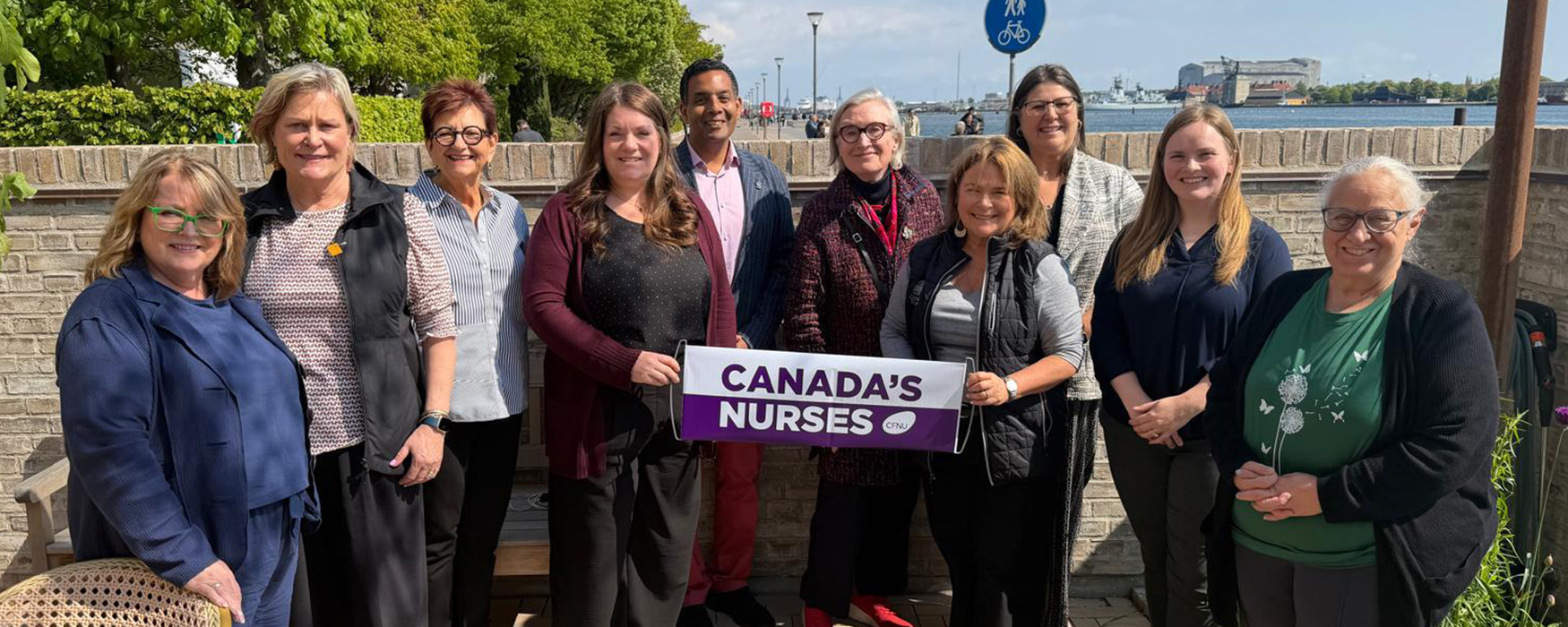
When ONA member Joann Carey was asked if she would be willing to take a trip to Denmark with the Canadian Federation of Nurses’ Unions (CFNU) this past May to check out their long-term care (LTC) system, her first thought was it must be a joke.
“[ONA Provincial President] Erin Ariss was supposed to go because there were union representatives from many provinces, but she couldn't make it,” Carey explains. “I’m the chair of ONA’s Nursing Homes Provincial Negotiating Team, so she asked me if I would do it because I have a long-term care background. Once I realized she was actually serious, I said yes, absolutely! I was very excited!”
Just a week-and-a-half later, Carey set off for a nine-day tour of the small Scandinavian country (population six million) as part of the 10-member CFNU contingent, led by CFNU President Linda Silas.
“We went to look at elder care in Denmark because that country has a much better system than we do, and the CFNU is writing a paper about it,” reveals Carey, calling the country beautiful and clean, and the people friendly and warm. “We were invited by the CFNU’s counterpart in Denmark, who hosted us along with other groups.”
The Danish Nurses' Organization represents approximately 75,000 nurses in the country’s five regions under a vision that ONA members can certainly appreciate: We move boundaries – in the organization, profession and society.
Whirlwind
The tour Carey calls a “whirlwind” began in the capital city of Copenhagen before moving to three other urban areas: Odense, Rodorve and Aarhus.
Denmark’s LTC system is designed to support elderly citizens in maintaining their independence and dignity, and includes a range of services such as home care, assisted living, nursing home facilities and specialized care (for people with dementia, for example).
The CFNU contingent had the opportunity to experience them all.
“The home that really stood out to me was for dementia residents,” Carey explains, referring to OK Fonden Dyruphus nursing home. “Residents are allowed to walk anywhere within the property because it’s all contained. It has a bird aviary and sheep wandering around, which they can visit. So, they have the freedom of going in and out by themselves.”
Another home the CFNU group visited, House of Generations, had an entirely different approach altogether, based on the residents it serves.
“These kinds of homes have long-term care, family and student areas – some have areas that are just for dementia patients – and were integrated to the point that residents and families would be on the same floor. Families have full apartments and most seniors are in communal areas. They have their own bed and bath, but share a kitchen and living area, so they can cook, eat and relax together. They help with laundry and to prepare dinner, so they’re involved and in a normal routine.
“Students can also cook, watch TV and socialize, which gets them out of their rooms. The staff also tries to keep dementia patients to a routine that involves helping out and other activities. They have a daycare too, and it was lovely to see the seniors with the children, teaching them to sing their song to help keep their traditions going. It was amazing to see the smiles on all their faces."
“Denmark tries to ensure their elderly people have a purpose and feel valued because so often, people get to a certain age and feel like they don't have that anymore. In many cases here, it’s just, put them in the home.”
Funded through taxes
Denmark’s LTC system, which is primarily operated by the country’s 98 municipalities, is laser focused on keeping seniors at home for as long as possible.
“They have a great home care system too,” Carey explains. “Home care can go in up to eight times a day. And home care nurses are very specialized, so they do a lot of different techniques, IVs – whatever they need to – to keep them out of long-term care until they need more care.
“And if it gets to the point of needing some sort of long-term care home, that care is funded through taxes. Danish people do pay very high taxes, but that’s what you get for it. It doesn't cost them anything to go into a long-term care home or receive care in their own home. It's all the same and it’s all covered. There aren’t the various levels that we have here based on what you can pay.”
Those taxes also ensure there are enough nurses, Carey adds, noting that wherever the CFNU group went, “the staffing was good. They have enough nurses. And that’s how they have time to do all these things with residents. And whatever the equivalent of a personal supporter worker is in Denmark, they have enough of those too.”
Nobody waiting
While the tour focused heavily on LTC, the group also had an opportunity to visit a hospital.
“The thing that struck me the most is how quiet it was because nobody was waiting in the ER,” Carey says. “People call the ER first and get triaged over the phone to see if a home care nurse can go see them or if they can wait to see their family doctor or if they need to be given an appointment to come into the ER. So, no one is sitting around in ERs just waiting like here.
“And there are a lot of things, like an elderly person with a urinary tract infection, where taking them into the hospital is just going to make them more confused. So, if you can treat that at home, it’s so much better. Nurses in Denmark can do urine testing and blood work and get almost immediate results. Then they can call the doctor to get an assessment and advised on what treatments to start. And again, because they have adequate staffing, people aren’t waiting hours to see a nurse at home.”
Eye-opening
While calling this glimpse into Denmark’s health-care system both eye-opening and enjoyable, Carey says her key takeaway is that elderly people can and should be treated with dignity and respect.
“They have a lot of wisdom to share and can still have a fulfilling life instead of just sitting in a wheelchair and watching TV because there aren’t enough staff to engage with them. It’s such an amazing system there, and it was so nice to see the residents all interact. They were just so happy. And I think that's the difference. I work in a nursing home here and the residents aren’t happy.”
But she hopes the CFNU’s upcoming paper, in which she will be a resource, can make a difference, with the ultimate goal being to lobby the government for a similar approach to LTC here.
“I think it's something that would take years and years to do. But the thing is, if Denmark can do it, why can’t we? Government policies need to change.”
Read more about Denmark’s LTC system here.