It seems scarcely a week goes by that ONA doesn’t learn of more cuts to RN positions in some part of the province.
While these cuts, which total tens of thousands of hours of lost RN care annually, are happening to other health-care professionals and in many sectors, RNs in hospitals and long-term care (LTC) have been impacted the most.
It’s a situation that’s deadly serious.
Higher workloads
“RNs are being replaced with RPNs, but at significantly lower rates,” explains member Holly (we’re not using real names in this story to protect our members), whose large urban hospital is cutting almost 300 RN positions. “They’re also cutting personal support workers [PSWs] and unit clerks. Our supervisor says there will be no reduction in service, but this translates into even higher workloads for all of us. I’m terrified that mistakes will be made and near-misses will happen because there aren’t enough staff to assess, reassess and intervene in a timely manner.”
Member Simran is already seeing that at her large urban hospital, noting that “we have an atrocious ratio of one RN to nine acute medical patients, and there are increased skin injuries, falls risk, isolation, behavioural issues and precaution breaches as a result.”
They’re right to be concerned. Statistics show that every patient added to a nurse’s workload is associated with a 7 per cent increased risk of hospital mortality.
Fewer front-line RNs also mean that patients are waiting longer for services, communities are losing access to care, and ONA members are becoming even more stressed, burnt out and fed up. The Canadian Federation of Nurses Unions’ (CFNU) National Nurses Survey, released in April 2026, found that 71 per cent of nurse respondents reported regularly working overcapacity, with more than half rating the stress in their jobs as high or very high.
I’m stressed before I even go to work because being short-staffed is a constant reality.
“I’m stressed before I even go to work because being short-staffed is a constant reality,” relays member Arlene, while fellow member Lily adds, “I’m so tired of being short at work. I’ve been an RN for 30 years and have worked it all in long-term care. I love this work, I love my residents and feel privileged to care for them, but we have never been so short-staffed as the past year, and management doesn’t step in to help or ask if we’re alright. We’re not alright. We’re exhausted.”
So exhausted, in fact, that one-third of nurse respondents to the CFNU survey are considering leaving their current job or the nursing workforce altogether in the next year. With Ontario maintaining the dubious distinction of having the lowest RN-to-population ratio in the country, needing 26,000 RNs just to catch up to the national average, this will only exacerbate an already dire situation.
ONA is also concerned that too many nurses are stuck in part-time or precarious roles, when full-time positions provide stability for workers, improve patient care, and strengthen recruitment and retention across our health-care system.
While several jurisdictions in the world and provinces such as Novia Scotia and British Columbia have implemented safe staffing ratios with great success – something an arbitrator completely ignored in ONA’s last hospital provincial contract – the Ford government is refusing to do the same in Ontario.
“This is absolutely a health-care crisis,” warns ONA Provincial President Erin Ariss. “Safe nurse-to-patient staffing ratios have been proven in these other jurisdictions to improve care, save money over time and help recruit and retain nurses. More nurses, not fewer, will also help address the disturbing levels of workplace violence our members face every day because we know full-well that understaffing is the biggest contributor.”

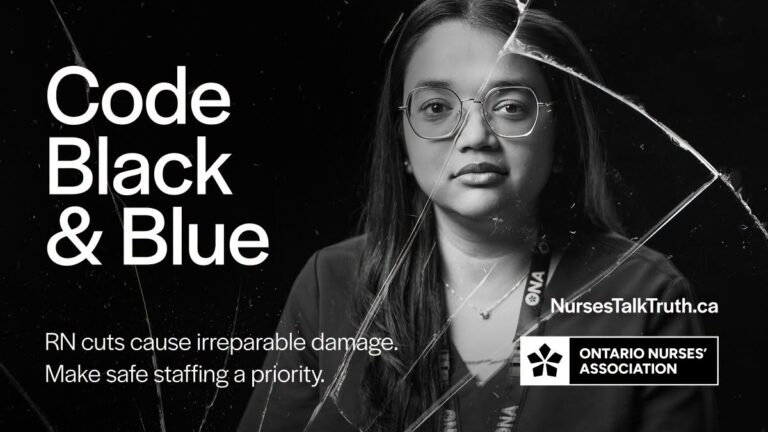
ONA’s impactful Code Black & Blue campaign, focusing on safe staffing, is comprised of ads and social media shareables, including this one featuring one of our dedicated members.
Why the cuts?
Tragically, it’s not difficult to see why these RN cuts are happening. There have been clear warning signs coming from the Financial Accountability Office (FAO), whose budget outlook projected a $10.7 billion health funding shortfall by 2027-28 under the Ford government’s current spending plan. The FAO report revealed that if this government fails to improve health-care funding, 7,263 nurses could be cut by then.
“The brutal truth is that the Ford government has deliberately underfunded public health care for years to pave the way for increased privatization – and the only ones who benefit are their corporate buddies,” adds Ariss. “But diverting public taxpayer dollars into corporate profits while resources, including staff, are pulled away from the public system, does nothing to fix health care. It’s does quite the opposite.”
While the Ford government announced a $1.1 billion “funding infusion” for Ontario hospitals in its March 2026 budget, the Ontario Health Coalition, which tracks and reports on funding levels, says the need is more than double that.
As a result, the Canadian Centre for Policy Alternatives’ report Failure, by design: Ontario’s deepening hospital funding crisis reveals that more than 70 per cent of hospitals are forecasting deficits and some are using their reserves to fund operating expenses. When health-care organizations are starved of much-needed funds and struggle to balance their budgets, they very often turn to their front-line staff first.
“We’ve been told by management to expect layoffs in the next few years because of financial restraints,” member Mark tells us. “But on the flipside, we’re seeing frivolous spending on external consulting businesses for make-work projects. Our concerns are ignored. It leaves us feeling like we’re indispensable and don’t matter.”
Fellow member Dahlia can relate: “My employer cut RNs because of a new model of care and their budget, and merged two units into one. Guess what’s happened since? No RNs, more RPNs and ‘skilled-up’ PSWs, and an increase in acuity of patients. Enough is enough.”
This is particularly concerning because RNs have specialized education and training that gives them the knowledge, skills and ability to independently intervene, think critically, problem-solve and make life-saving decisions, especially with patients who are unstable, unpredictable and who have multiple complex conditions.
While the Ford government insists everything is fine – and has, in fact, continued the narrative that thousands of nurses have been hired – the statistics don’t lie. ONA has launched a webpage on RN cuts that includes a tracker to show, in real time, the number of RN and health-care professional positions that have been slashed since January 2025. These alarming numbers, totalling more than 1,400 at time of writing, are provided by our Bargaining Units, and aren’t the pie-in-the sky figures the Ford government appears to pull out of a hat.
Also deeply troubling is that some Ontario hospitals are required to submit three-year spending plans showing how they will prepare for tighter budgets in the coming years, which the Ford government promises will have no impact on services. But as those plans begin to roll in, that same government is declining to share them publicly, saying doing so would be bad for the economy.

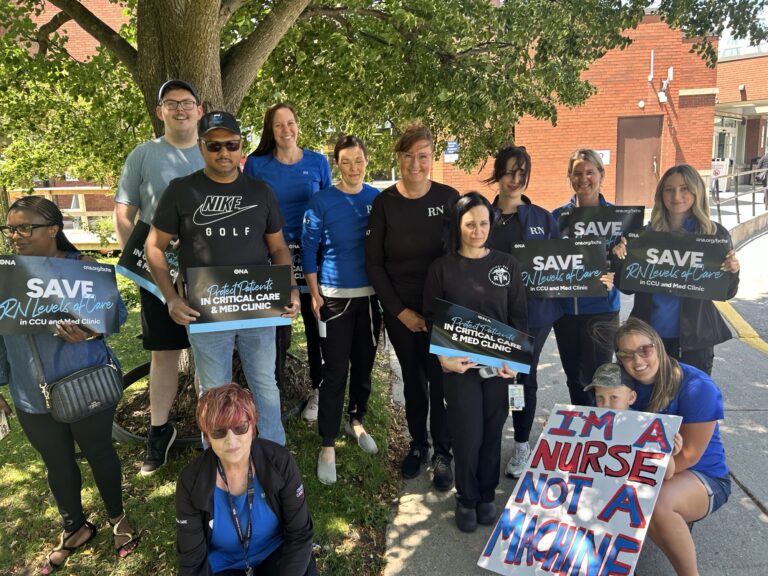
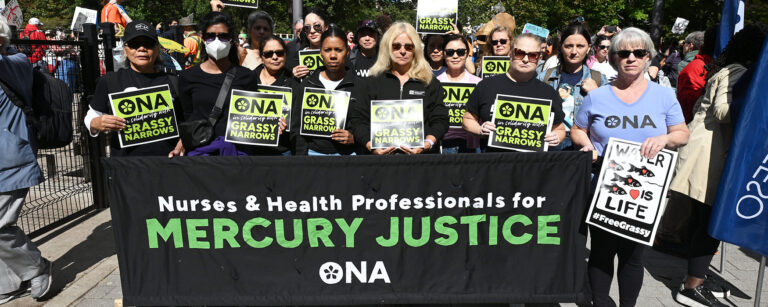
When positions are cut in their places of employment, ONA members, including this feisty group from Brant Community Healthcare System, speak up and fight back!
Fighting back
Our message to the Ford government is clear: immediately issue a moratorium on further RN cuts, and work with us to implement safe and mandatory nurse-to-patient ratios. After all, no one knows how critical this is more than our members.
And those members aren’t sitting back and taking it.
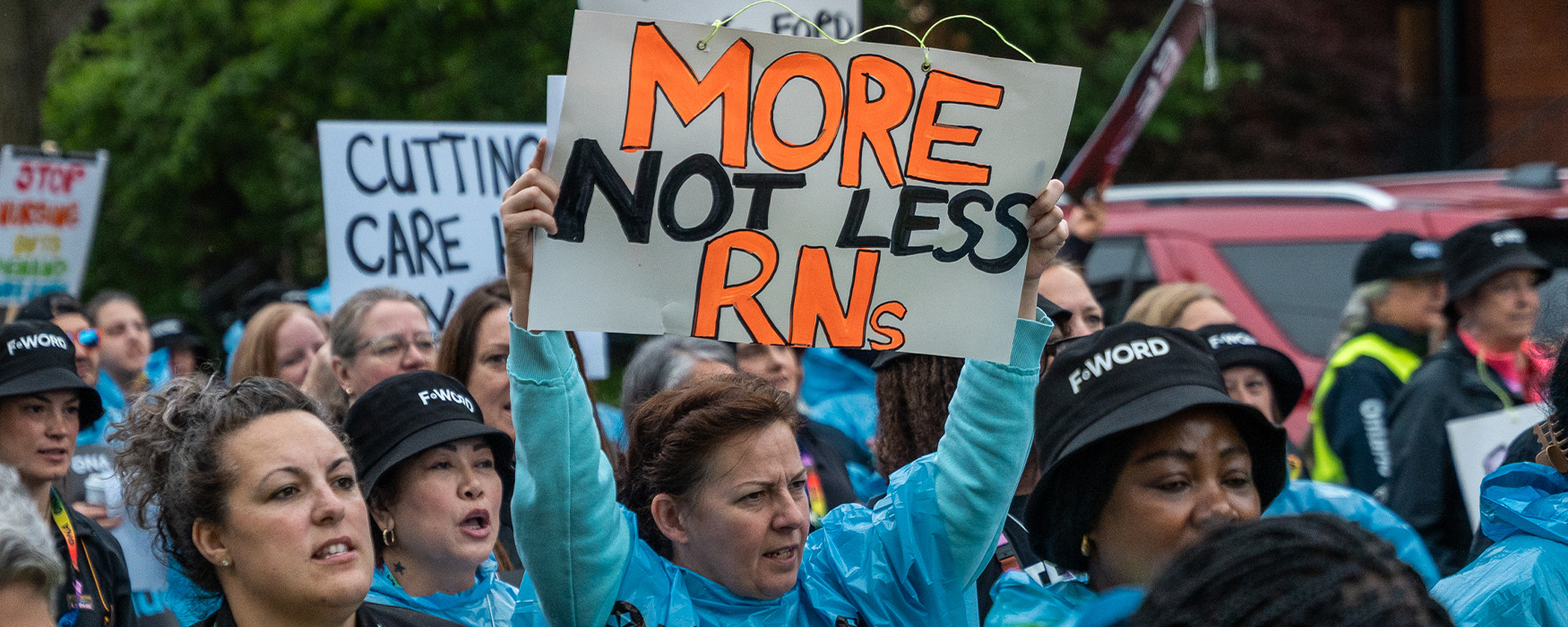
They’re participating in provincial and local “Care, not cuts” rallies, marches and info pickets. They’re featured in ONA’s powerful Code Black & Blue public awareness campaign on safe staffing ratios, pulling back the curtain on their grim realities. They’re using ONA’s grievance and professional responsibility complaints processes, with member Arjun telling us, “I worked in a rural ED with only two RNs. As a unit, we drowned the employer with workload forms and won significant changes.” They’re signing and collecting signatures for safe staffing petitions in the most creative ways, including at festivals, farmers’ markets and Pride events, heightened during ONA’s Community Month of Action this past July. And they’re organizing their members like never before.
Take ONA members from Brant Community Healthcare System, for example. When they learned about cuts to 21 RNs in multiple departments, they sprung into action with the support of ONA staff, leafletting their community and producing a banner petition outlining their concerns for their CEO, which was signed by an overwhelming 89 per cent of them.
And it’s clear from recaps members have provided about their conversations with the public, they’re on their side. After all, underfunding and understaffing in our public health-care system has devastating impacts on everyone.
“Since this government has been in power, it has done nothing but cut budgets and funding,” Randy Knipping, one of those concerned members of the public, tells F-Word. “Our nurses are the backbone of our health-care system. What I saw them do for 12 hours-plus a day when my mother was in the hospital was nothing short of heroic. Shame on you, Mr. Ford!”
The planned nursing cuts are terrifying for my family and many others.
Another member of the public, who asked that her name not be used to protect the identify of her son, a regular patient at London Health Sciences Centre’s Children’s Hospital, says “the planned nursing cuts are terrifying for my family and many others. To know we’re potentially going to lose highly trained nurses and have them replaced with individuals who don’t have that same training isn’t OK, and the consequences will be felt heavily. There are already not enough of them.”
And so, we keep fighting.
“While ONA will continue to aggressively lobby the Ford government for safe staffing ratios, an end to privatization and the creation of full-time RN positions in every way possible – and demand appropriate staffing levels from our employers during collective bargaining – it will take all of us to turn this disastrous situation around,” concludes Ariss. “I implore all members to join us.”
Member Kamau already has.
“Recently, I have become very loud about the workplace concerns my team is facing with 12 to 13 patients on our day and night shifts per staff. I will make us a priority. I will make patient safety and quality care a priority. I will not be silenced.”
Learn what you can do here.