It’s a fight 60 years in the making – and ONA members are here for it.
During Nursing Week, ONA launched a constitutional challenge to strike down the antiquated Hospital Labour Disputes Arbitration Act (HLDAA), which regulates collective bargaining for hospital and long-term care employees, mandating that contract disputes be settled by binding arbitration, rather than meaningful collective bargaining, including job action.
“While nurses are being celebrated this week, they’re also being stretched to their limits and robbed of the right to meaningfully fight back,” ONA Provincial President Erin Ariss said at a media conference to announce the HLDAA challenge. “They’re at a critical crossroads between their professional responsibilities and the legislative limits placed on their ability to advocate for meaningful change through collective bargaining.
“This legislation violates the constitutional rights to meaningful collective bargaining, including the right to job action for more than 90 per cent of all health-care workers in Ontario. It guts our bargaining power, applying a blanket ban on any form of job action for nurses and health-care professionals working in hospitals and long-term care homes, even actions as simple as taking our breaks.”
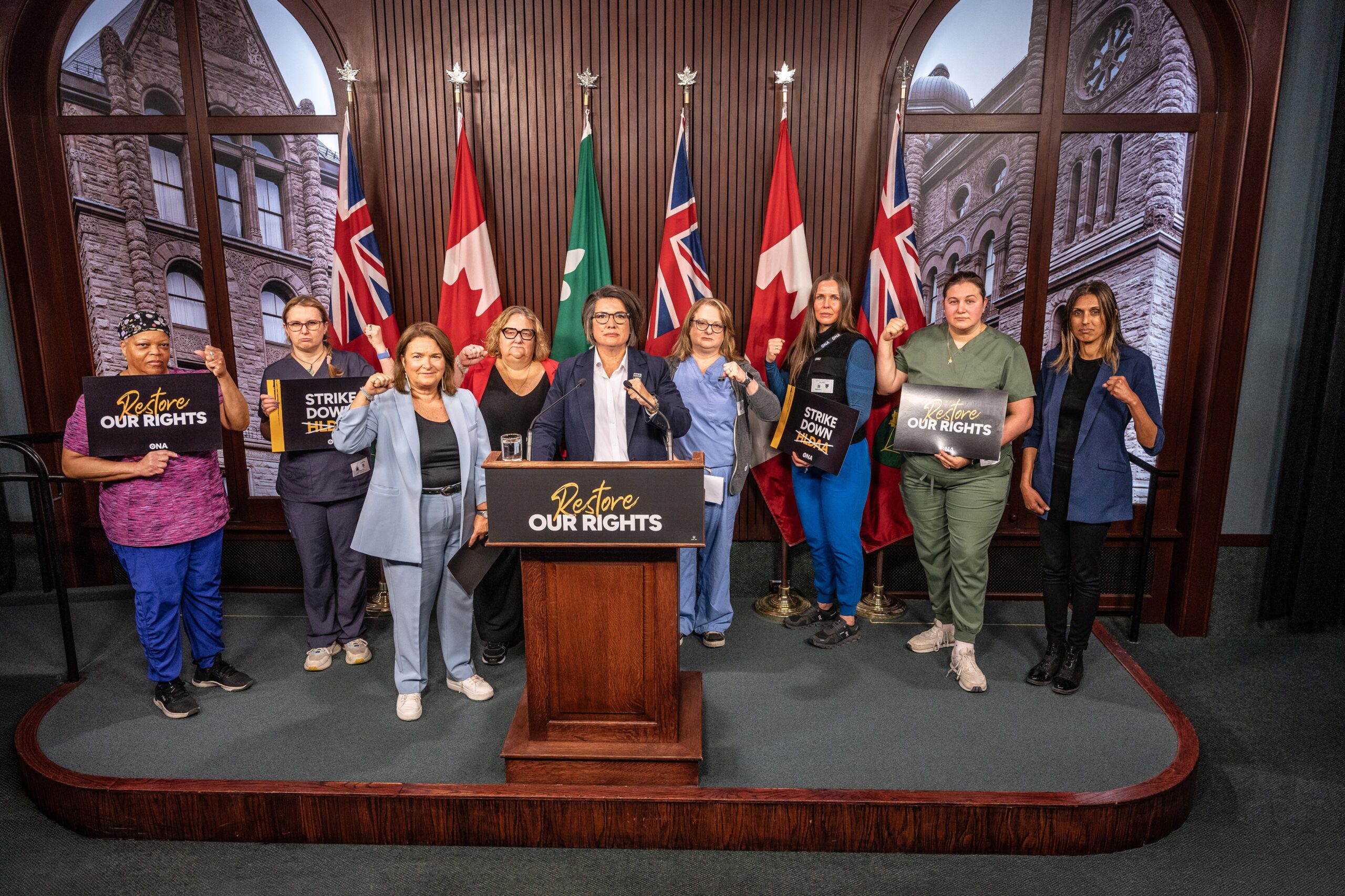
Standing in solidarity with Ariss at the media conference were five ONA members holding Strike Down HLDAA and Restore our Rights signs, CEO Andrea Kay, Ontario NDP Health Critic France Gelinas, Canadian Federation of Nurses Unions (CFNU) President Linda Silas, Legal Counsel Danielle Bisnar and Chief Legal Officer Sharan Basran.
“I’m here because I want to put the power back in our hands,” explains one of those members, Meaghan. “I see other unions being able to have a stronger bargaining power because they have this right and can say, ‘this is what we’re going do,’ and ONA members want that same power.”
Her fellow member Janet echoes that sentiment, noting, “we should have the right to strike to advocate for fair wages and working conditions while maintaining essential patient services. It’s important that we stand up for change for the next generation to come, as many nurses and health-care professionals are going to be retiring in the next five to 10 years. And if we don’t speak up now and advocate for change, we won’t be able to create a better working environment for our nurses and health-care professionals to come.”
Deprived
Passed in 1965, HLDAA is among the most restrictive labour relations legislations in the world, enacted before the Canadian Charter of Rights and Freedoms existed. It’s also a gender equality issue, as more than 90 per cent of workers whose right to strike is removed are women.
Hospital employers haven’t reached a negotiated settlement with ONA for more than 15 years, instead relying on arbitrators to impose contracts that consistently fail to address crucial system issues such as equal wages and understaffing. Agreements arrived at with other unions have typically followed ONA, often mirroring our outcomes as leaders in the sector.
Despite the longstanding issues, the tipping point with HLDAA came last year. Arbitrator Sheri Price imposed a hospital contract that completely ignored our members’ top demand – nurse-to-patient ratios – which are mandated in several other provinces and jurisdictions around the world with positive outcomes.
Provincial bargaining for our nursing homes members also broke down this spring after employers refused to change their position and negotiate meaningfully, opting to move to arbitration instead.
“Nurses and other health-care workers in Ontario are being deprived of the right to free collective bargaining, which is afforded to health-care workers in other jurisdictions in Canada and countries around the world,” Silas told the media conference. “The CFNU stands in solidarity with ONA as it challenges this unjust law in the courts.”
She added that strikes don’t mean patients lose all access to care. In British Columbia, for example, where nurses may be hitting the picket lines after the BC Nurses Union determined that the offer on the table didn’t meet nurses’ and patients’ needs, their rights grant limited job action because nursing is an essential service. And when nurses in other countries have taken job action as a last resort to address inadequate working conditions and fair compensation, essential or life-preserving services are maintained.
“Nurses’ strikes aren’t dangerous to be engaging in,” Ariss responded to a reporter’s question. “I’ll tell you what is dangerous though. When you have one nurse to 50 patients in emergency department waiting rooms or one nurse to three or four delivering mothers in Labour and Delivery units.”
Not just numbers
“I know my patients and what they need,” ONA member Peggy Dawson explained at the media conference. “My colleagues and I know what safe care looks like. Arbitrators don’t stand at the bedside. They don’t know the realities of a short-staffed unit, a hallway patient or a nurse responsible for too many complex cases at once. Arbitration looks at legal arguments and financial considerations. But health care is not just numbers on a page. These are human lives. If nurses are prevented from taking meaningful job action, how can we truly show the public the urgency of what is happening inside our hospitals?”
Her fellow members agree.
“Nurses are the primary witnesses to the successes and failures of the health-care system,” says member Kerri. “Our right to meaningful collective bargaining backed by job action ensures that policy decisions are informed by those who actually deliver care, rather than just those who manage the budget. That safety is a priority and that nurse-patient ratios are front and centre.”
“This challenge is so important because the Ford government keeps chipping away at the foundation of our health-care system, but acting shocked when it starts to wobble,” adds member Carolyn. “Enough is enough. Ontario deserves better. No one wants it to come to job action, but when employers continually come to the negotiating table unprepared to engage in meaningful conversation, something has to change. We’re no longer accepting the status quo.”
She’s right. ONA members are fighting back like never before.
“Three years ago, during my first Nursing Week as ONA President, I got kicked out of the Ontario legislature for speaking up for our members,” concludes Ariss. “And now here we are standing strongly in solidarity against an archaic piece of legislation for the benefit of not only nurses, health-care professionals and our patients, but all Ontarians. This is a brand-new ONA, and no one is kicking us out now. We will be heard.”